|
The Saga of John's 1895
Mauser.
By
John Fuhring
Note: This is a STORY that contains technical, historical and autobiographical material.
Please don't expect it to be a collection of statistics and facts.
History
and background
It all started in
the early 1880's
when the French chemist Paul Vieille developed a process to
manufacture smokeless powder - called Pouder B – that was
safe to
use in a firearm. Since the invention of the firearm and especially
after the American Civil War, armies wanted a better propellant to
replace the dirty black powder then in use. Black powder is
especially nasty because heavy fouling builds up in the bore of a
rifle and covers the rifling thereby destroying its accuracy. There
is also a highly visible puff of smoke when the rifle is fired and
many rifles firing together will create a fog of smoke so dense, you
can't see what you are shooting at. No, the armies of the world were
desperate to get rid of black powder, but the other, cleaner,
propellants were just too dangerous until Vieille developed his
process.
The French, still
very much
smarting from their humiliating defeat in the Franco-Prussian War and now having this wonderful new propellant,
quickly developed the world's first smokeless cartridge and a (then)
high tech rifle (the Lebel) that could shoot it. This sent shock waves through
their principle enemy, the young German nation and so the German
government put together a military commission to develop their own
smokeless cartridge and an advanced technology rifle to shoot it.
The Commission took
in all the
latest cartridge design ideas (mostly from the Swiss), and then
developed their famous 8X57 MM cartridge. To this day, this
cartridge is throughly modern looking and (with a slightly larger
bullet) is still used in rifles today. The Commission
then contracted with a Jewish sewing machine manufacturer who had a
reputation for making precision machinery of the highest quality. This
was the famous Ludwig Loewe of Berlin who then began manufacturing the
famous 1888 Commission Rifle (the GEW 88). There were two things
that made the Commission Rifle superior to the French Lebel as a
military weapon: (1) it fired a cartridge superior in design
and function to the very odd Lebel cartridge (although it must be
said that the overall ballistics of the two cartridges were nearly
identical) and (2) it had a vastly superior Mannlicher magazine that
was loaded by inserting a clip of 5 cartridges (later modified to a
stripper clip cartridge charger) so that it was ever so much faster to
reload than the French rifle with its ridiculous tubular magazine.
By the way,
nearly
all hunting and military rifles today shoot cartridges very similar to
the 1888
8X57, but few or none shoot anything like the Lebel cartridge.
One exception might be the 8 MM Steyr Mannlicher rifle used
by the Austrian Army. It's cartridge is almost as odd as the
Lebel's and it likewise failed to survive past WW 2 as a military or
hunting cartridge. Other exceptions might be the Enfield .303 and
the Russian
Mosin-Nagant and, although their cartridges are rimmed, neither has the
very
odd shape of the Lebel.
As busy as the Loewe factory was
turning out the 88 Commission Rifle, the factory's design department,
headed by the famous Mauser brothers, was busy designing improved
rifles for the export market. The
Mauser brothers greatly improved certain
features of the Commission Rifle using their own ideas and Ludwig Loewe
started selling Mauser rifles to governments and hunters all over the
world. The Mauser rifles Loewe manufactured for export were the
most
technically advanced rifles made anywhere and were beautifully
fabricated from the
highest quality steels and components. The steel was expertly
heat-treated and
hardened and
the metalwork was beautifully machined and finished.
After this,
every country (without a domestic arms industry) wanted a Mauser,
so models (all similar to each other) were produced for scores of
countries ranging from Argentina to Mexico to Turkey. When Kaiser
Wilhelm
boasted to the
world about the unmatched quality and excellence of German design and
manufacturing, almost always it was Loewe's Mausers he was referring to.
During their ballistic experiments
with different diameter and weight bullets, the Mauser brothers
realized that the new
smokeless powder and the new rifles they were designing would be
even more effective
if they reduced the bullet diameter from 8 MM to 7 MM and reduced the
weight from 225 grains to 170 grains. They took the 8X57
cartridge and necked it down for the smaller bullet and came up with
the
famous 7X57 cartridge. In
1893, the first
7X57 MM Mausers
were manufactured and sold to the Spanish Government. To say the
least, this rifle and its cartridge was a sensation. In 1895, a
very similar, but slightly
improved model was produced for Chile and large numbers of that model
were also sold
to the Boers of South Africa for use in their fight against a British
Empire take-over of their country.
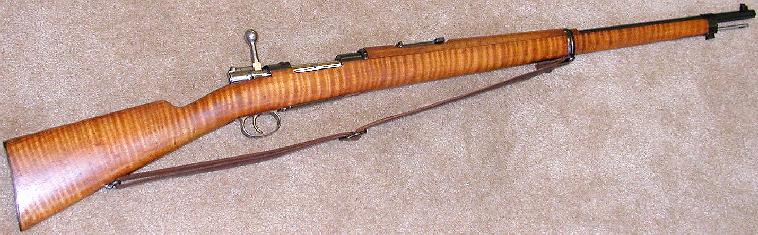
1895
Military Mauser
My
Mauser was battered and
well used and no where near this beautiful condition.
The first real
military use of the 7X57
came during the
Spanish American War in 1898. When the
American Army invaded Cuba, they came up against vastly inferior
numbers of Spanish soldiers armed with their 7X57 Spanish Mausers and
the U.S. soldiers
got their butts kicked - hard. Thousands of U.S. soldiers were
held
back until they could overwhelm the Spanish
positions by sheer numbers and only after suffering large causalities.
The
7X57 Mausers proved vastly superior to our old black powder 45-70s and
even our new
smokeless 30-40 Krag-Jorgensen's.
This embarrassment on the
battlefield resulted in a
demand for a new rifle and cartridge since (unlike the Enfields) the
30-40 Krag-Jorgensen's action was too weak to stand up to a hotter
powder
charge. The demand for a new rifle and cartridge resulted in the model
1903 Springfield rifle and
the 30-06 cartridge. It so happens that the design of the
Springfield
Rifle is based
almost
entirely on the Mauser Rifle and the 30-06 cartridge is
almost identical to the 7X57 except it is stretched out to hold more
powder
and necked up for a .308 caliber bullet (since we had millions of .308
bullets manufactured for the Krag-Jorgensen's). America had
ripped off
the
designs from Mauser so blatantly, the US had to pay patent infringement
penalties
to Germany up until WW 1 and then to a holding company after that.
By the way, in the 1950s the U.S. Army finally realized
that the 30-06 cartridge's extra length wasn't necessary and so it was
reduced down to 51 MM for the M14 (NATO .308). The 51
MM NATO cartridge has been necked down for 7 MM bullets and today they
make
hunting rifles in
7X51, but they are ballistically no better than rifles shooting the
older 7X57
Mauser cartridge.
The second
military use of the 7X57
came a
little later (starting about 1900) during the Boer War. The
British were using rifles chambered for their “new,” but actually very
old fashioned,
.30 caliber rimmed cartridge. Some British units were armed with
the Lee Medford rifle that used the .30 caliber rimmed cartridge, but
their cartridges were loaded with compressed black powder
- yes, black powder. Other units were armed with the newer, but
nearly identical Lee Enfield
Rifle that shot a cartridge that looked identical, but was loaded with
a smokeless propellant they called cordite.
Because of the 7X57 cartridge and the superb rifling of the 1895
model Mauser rifles, they were far
superior
to the Lee Metfords and out gunned the Lee Enfields too. Many
British soldiers were
killed and wounded at ranges and with an accuracy the British
couldn't match. The “small” 7 MM (.28
caliber)
bullet was also
surprisingly deadly, even more so than the larger and heaver .30
caliber British bullets. This caused the British to
completely redesign how their bullets worked and to abandon black
powder entirely
in favor of cartridges loaded with cordite.
By the
way, the British kept the old rimmed cartridge (even through WW 2)
after the changes they made brought the performance of their
cartridges and bullets up to Mauser standards.
After WW 1, there
were a lot of beautifully made
hunting rifles (called Plezier rifles) still in use in East Africa
(particularly in the game-rich
former German colony of Tanganyika) and many of them were in
the 7X57 caliber. The very famous Elephant hunter of East Africa,
Walter Bell,
preferred the 7X57 to all other cartridges because the recoil is so
light and yet the long 7 MM military bullet has an amazing penetrating
power.
Rifles shooting the 7X57 cartridges are comfortable to shoot so that
when they fire, the shooter
does not tend to 'flinch' and mess up his shots. Because of this,
some
very precision shooting can be done with them. Bell discovered
that
the penetrating power of a standard military 170 grain full metal
jacketed bullet together with the ease of holding
the rifle on target combined to make the 7X57 a highly effective
elephant cartridge – as “tiny” as the
bullet was.
Walter Bell went on to
professionally kill more elephants with the 7X57 MM cartridge than have
been killed by all the many “elephant gun”
cartridges
combined and that is an amazing record that stands to this day. Today
it is illegal to shoot elephants (where elephants are legal to
shoot) with a 7X57 because few hunters know the cranial anatomy of
the elephant or are as good a shot as Bell was.
Today, to be legal,
you must use something like a .470 Nitro Express shooting a 500 grain
bullet
with 120 grains of smokeless powder. You must
also be able to stand the huge blast and a bone breaking recoil (about
10 times more than my Mauser) all
without flinching so badly you miss the elephant (or other
dangerous game) altogether
– something
that
few shooters can do. A modern elephant gun is so intimidating
to
shoot that it's hard to hold on target and it's easy to miss what
you're shooting at.
Missing
or failing to disable an angry elephant (or other dangerous game) will
likely result in
a greasy spot on the ground where your crushed body once was and your
sad fate will become a topic of scurrilous jokes told by cruel hunters
around their campfires. The moral of the story: don't shoot any
rifle with a
cartridge and bullet weight one bit bigger than you can hold on target
without flinching.
.
How
and why I got my 1895 Mauser
Now, let's fast
forward to 1960. I was a young teenager and across the street lived a
family with a
son the same age as me. Bobby's father had a WW II era jeep and he
and his son would roam the back country during deer season and oh god
I wanted to go too. I hitched a ride in the back of the old jeep a few
times, but didn't have a rifle, nor would my parents allow me to
buy one, so I couldn't actually go hunting with them. The truth is,
I have always hated killing things and my prime motivation was not
the prospect of shooting a wild animal. I just wanted to experience
the out doors in an exciting and dramatic way and just going out
driving around the countryside during deer season seemed like a pretty
stupid thing to do for various reasons. First the Game Warden is
going to suspect you of hunting without a license, the hunters are
going to resent you stirring up the game for nothing and wandering
around out there might get you shot by accident and all for nothing.
As mentioned, my
parents were
totally against me owing anything more powerful than a .22 and
very much against hunting in general. My parents were meat eating
people, but who
didn't believe in killing things themselves, Like so many
people,
they somehow felt that
eating meat is OK as long as somebody else does the killing and does
the bloody butchering. Even as a kid, I've always thought that if
you are going to eat meat (and eating meat is why our ancestors
survived and the vegetarian hominids became extinct) then, by
everything that's fair, you should experience for yourself the
brutal, bloody, stinking and messy thing it is to kill and prepare
animal food. In my case, it has given me greater respect for
animals and what
they endure to feed us. Killing, eviscerating and butchering
game
animals has had the effect of limiting the
amount of meat I actually eat because I now understand what actually
occurs.
If anything, my hunting
experiences have given me an enhanced sense of reverence for Nature.
Of course, I've also met hunters who have no reverence for
anything. I've met hunters who
just love to kill things and have a beautiful work of Nature die in
front of them as if
somehow that gives them power over life or something. The
power
of death is nothing, any fool who can afford a rifle has it. It
is in conserving a vibrant natural environment and a reverence for
Nature that takes intelligence.
Anyway, back to the story.
Regardless of my
parent's
feelings and my own reservations, I wanted to go hunting with Bobby and
his dad, but for that
I'd need a rifle – which I couldn't have. One day I was in
the
old
Sears Warehouse (when they had one here in town) and I saw a guy
behind the counter playing with this beautiful old rifle. I asked him
about it and he told me it was a Mauser and it shot a bullet very
similar to the famous .270 that Bobby's dad owned. I asked him how
much for the rifle and he said $19.00. I could easily afford $19.00
(around $200.00 in today's money) because I had made money selling news
papers on the street since age 11 and was presently working in a drug
store. I asked the
clerk if he'd sell me the rifle and he said "sure" – no gun
laws
back in those days. I gave the guy the money, tied it on my bike (kids
could do that in those days without the 'SWAT' team being called), took
the rifle home and
hid it away.
I then bought some
old pre-WW 1
ammunition for the thing – boy do I wish I would have saved
some of
it because it was really old fashioned with rounded silver colored
bullets that would now be a valuable collectible. Anyway, the
ammo was cheap and
powerful and friends and I would secretly take my Mauser shooting at
the Santa Maria River bed. The original round nosed bullets were
hard and powerful and it was fun to shoot the doors off of abandoned
cars down there by aiming at the thick steel hinges of the doors.
Those bullets would also penetrate the six cylinder engines and
cause them to smoke. That was really fun and I smile now thinking
about it. Later I bought more modern military "spitzer" bullets,
but my fun was over when I aimed at a door hinge about 20 feet away and
before I was aware of the rifle going off, I felt a stabbing pain on my
face. The "modern" bullets must have been much softer than the
older ones because instead of penetrating the thick steel, they
disintegrated, formed a crater and then the crater directed some of the
fragments back at me. My face was bloody and I picked out a
larger lead fragment just below my eye. Naturally, I said nothing
to anybody, but when asked about my face, I'd simply say that I was
having a particularly bad time with acne. Boy did I feel like an
idiot and I was so thankful that nothing got in my eye.
After
several months one of my friend's mother told my mother that I had
the rifle. Oh, there was a scene, but it was too late to forbid me
to have it and I had already shown that I could own and use it
responsibly, so I was allowed to keep it. After the cat was
out of the bag,
the first thing I did was to cut down the military stock and then I
took the barrel and receiver to a gunsmith to have the barrel cut
down, re-crowned, and new front sights put on. The thing looked
horrible, but at least it was a hunting rifle and I was all set to
invite myself to go hunting with Bobby and his dad when deer season
opened in the late summer.
Bobby's mom and dad
had a rocky
marriage and it didn't help a bit when another woman came in and
destabilized the marriage altogether. Divorce ensued with a tragic
and disastrous effect on my friend Bobby that made me profoundly sad
too. Of course, that meant that any chance to go deer hunting was
now dead and I had this old, ugly Mauser rifle as a useless piece of
junk sitting in a closet.
.
Completing
a 50 year project at long last
In a closet totally
forgotten, the
rifle sat for almost 50 years until I took an early retirement. I
started going through all my old possessions in an attempt to get rid
of old junk I didn't want or need any more when I found the old
rifle. Of course, this brought up a lot of memories both good and
bad, but the more I looked at the thing, the more I wanted to
complete a project started so long ago, but never finished. I've
always completed my projects, no matter how long they take, however,
this was one project that never got completed. As I looked at the old
rifle, I became fiercely determined to turn it into a hunting
rifle I wouldn't be ashamed of and to actually go deer hunting with it.
I didn't give a damn if I harvested any
game with the rifle, in fact I didn't want to, I just wanted to go
hiking in
the back country armed with my Mauser, loaded with hot, deer killing
cartridges and be ready to shoot if something should come into range.
First thing I
did
was to remove the old military stock and buy a nice
modern wooden stock and mount all the steel items securely into it. I
bought a nice looking walnut blank that was semi-inletting and then
proceeded to carve
it up and fit everything into it while filling all the voids with
epoxy for a tight fit. I then experimented with mounting a scope
forward of the receiver on top of
the old rear sight with very limited success. Since the scope was
forward of the receiver, I had to use a 'pistol
scope' that had a very long eye-relief. It was ugly as sin, but it was
far superior to the open
military type sights.
I took my new
“scout type”
rifle with the forward mounted scope and straight bolt to the
shooting range and was severely disappointed to see that the bullets
were all over the place. I tried several things to improve accuracy
and they helped, a little, but the thing was pretty much useless
for hunting because it was so inaccurate. I then performed a very heavy
copper
removal cleaning operation and removed an amazing amount of fouling
from the barrel. There was over 100 years of junk that came out of that
barrel so I was confident it would now shoot straight, but such was
not the case. To my great disappointment, the rifle still shot
badly.
At this point, I
decided that I
was in too deeply to just throw the thing away, so I decided to spend
the equivalent of a new rifle by having the barrel reamed out to the
8X57 cartridge size. I found a gunsmith, incompetent as it turned
out, who agreed to do it. Well after waiting about 8 months for the
rifle, he sent me a note that he had ruined the barrel, but he offered
to make
me a new one in the original 7X57 for the same price. I was very
disappointed because I
wanted to keep the rifle as original as possible, but I was pleased to
have it in 7X57 again so I told the gunsmith to go ahead with the
project.
Several weeks later
I received the
rifle back with the new barrel only to discover that the
“throat”
hadn't been machined and you couldn't load cartridges in the firing
chamber. I sent it back and a few weeks later it came back more or
less machined correctly. For a long time I was severely disappointed
with my new barrel because, to tell the truth, it didn't seem to shoot
a whole lot better than the old original barrel even with the deep,
precision cut rifling. I had never heard of "barrel harmonics"
and when I first heard of it I was extremely skeptical. After
some experiments I became a real believer and by using a couple of
different powder types (H414 and IMR 4320) and different weights of
propellant, I was able to improve the accuracy, but looking back now, I
have to admit that I never did achieve "tack driver" status and the
best I ever did was shoot at MOA (within about one inch of a calculated
center at 100 yards). I tried one of those silly looking rubber
"deresonators" with very limited success although I tried to fool
myself into believing that they worked. Although no "tack
driver," my rifle and its ammo is accurate enough for hunting and
that's plenty good enough for me.
Another thing I
wanted to do was
mount a conventional scope over the action and get rid of the forward
mounted pistol scope (the so-called "scout rifle" configuration). You can't use a scope with a strait bolt
handle, so I bought a offset bolt
kit and fitted it myself. I took the rifle to a great old
gunsmith who machined flat a portion of the charger guide at the rear
of the receiver and then he
expertly drilled and tapped the receiver for "Weaver" type scope
mounts that I had purchased from a supplier made especially for my
Mauser.
Having a real rifle scope mounted over the receiver vastly improved the
looks and function of the rifle.
The original "tang" safety flipped
up too high for use with a scope, so I fitted a low profile safety
lever myself that works well and looks good. Finally, I took off the
old military double stage trigger mechanism and installed an adjustable
trigger mechanism that has a snappy, light but safe pull. My
rifle is now about as complete as any custom-built rifle there is.
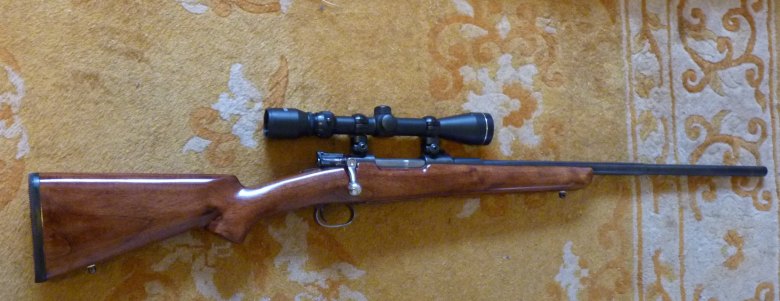
My 1895 Mauser as it looks today.
After the scope was
mounted, I
very carefully bore sighted the rifle so I'd be somewhere on a target
when I arrived at the shooting range. To my great disappointment, the
first
few shots showed a good pattern, but the pattern moved the more I shot
the rifle. I'd adjust the scope, but then it shot somewhere else and it
didn't make sense. I couldn't understand this until it occurred on
me that as the barrel heated up and as I gripped the forearm of the
stock differently, the barrel's press against the wooden
forearm of the stock was also changing and that resulted in a change in
where the barrel was pointing.
I hadn't considered it possible
for the barrel to interact with the stock because, after all, the
barrel is made
of rigid steel, right? On doing some research, I discovered that most
authorities recommend a gap between the stock and the barrel wide
enough to allow a dollar
bill to slide from the end of the stock to firing chamber to prevent
barrel-stock interaction. I was still skeptical so I took a optical
bore-sighting tool and attached it to the muzzle of my rifle. I
applied hand pressure on the wooden stock and on the steel barrel and
to my amazement, the sight pattern changed quite noticeably just by
gripping and pulling on the stock and barrel with minor amounts of
force.
I was now convinced that I needed
to "float the barrel" so I then proceeded to carefully
sand out the channel in the stock until I could slip two $1 bills all
the way down to the firing chamber without touching wood. After that, I
took the rifle back to the shooting range and was
gratified to see that the patterns did not depend on how many shots I
had previously taken. Judging from some discussions I've read,
“floating a barrel”
is a little
controversial and some shooters think you actually do harm to
your accuracy, but most authorities recommend the practice and it
certainly worked for me. One thing that must be avoided with a
free floating barrel is allowing anything to touch the barrel while
shooting and to only hold or support the rifle with the wooden stock or
your accuracy will be terrible.
.
The final task necessary to
complete the 50 year project
Well, a little over
a year ago I
hooked up with a guy who knows a little about where to hunt around
here and for the first time in 50 years, I went hunting with my
Mauser. It turned out that I didn't see a damn thing, not one single
buck and only one doe during the many trips we went out hunting from
August
to December. Actually, this
worked out for the best because I really didn't want to kill anything,
I didn't have a way to store the meat should I get a deer and I wasn't
looking forward
to a diet of deer meat for the rest of my life. Still, I was very
pleased that, after all these many decades, I could now say that my
Mauser project, started when I was a young teenager, had finally come
full
circle and I actually went hunting with it, I had carried it armed
and loaded and wasn't ashamed to be seen carrying it either. It was
a very good feeling to know that I had not let this project go
unfinished.
.
A
brief note on my cartridges for hunting.
I
reload my
cartridges myself using a hand loader and an accurate powder
balance and it's a good thing I do because cartridges with lead-free
bullets for the 7X57
Mauser are presently unavailable. Why should that matter?
It matters because certain rule-making people within the
California Fish and
Game Department believe in a certain very half-baked hypothesis.
The
hypothesis maintains that our nearly extinct California
Condors have been poisoned and their egg laying has been
deleteriously effected by their ingesting tiny lead
particles that may (or may not) be present in the (normally) discarded
internal
organs of shot game. Most lead cored bullets do loose a small
amount of metal as they pass through an animal's body, but it is a very
small amount and highly disseminated. No other species of vulture
or
scavenger seems to have ever been effected by lead in this way so many
people
think this
hypothesis lacks both scientific proof and common sense.
This
ruling has
led to a loss of respect for Fish and Game among many hunters, but the
law is the law, so non-lead bullets must be used.
To comply with
the law, I sent away for a supply of
rather expensive 'Barns Triple X (tm)' 100% copper bullets, loaded up a
box of cartridges, took them to the shooting range and found
that I
love shooting them. They are as accurate as any I've
ever
used in my Mauser and I do rather like the idea of not having to worry
about lead in my meat. Besides that, the copper bullets
penetrate
deeply and expand in a remarkable way to insure that game is killed
swiftly and humanely. In my opinion, these are the best bullets
on the market, with the only downside is the fact that they are double the price of lead core bullets.
For the larger
game
in this area and for ranges up to 300 yards, it is my opinion that 7 MM
bullets should weigh
140 grains. A bullet of that weight has the
power to kill
anything
ranging from bears to deer to the largest boar. I now load my
cartridges with 45 grains
of
H414
behind 140 grain all copper bullets for an average muzzle velocity of
just about
2700 feet per second
(as measured by my electronic bullet chronograph). For a 120
year
old
cartridge, this is pretty hot and yet it is not putting my old rifle
under any undue strain. The recoil from these loads is
pleasantly light, but strong enough to give you the very satisfying
feeling that you have just shot a deadly projectile. Overall,
this load makes my Mauser a very fun gun to shoot and there is nothing
unpleasant or intimidating about firing it. My only complaint is
that this load does not produce the coveted "sub MOA" groupings and
indeed I have not been able to shoot even two (2) MOA groups with this
powder and bullet combination. Certainly this is good enough for
hunting, but somewhat disappointing.
The
external ballistics of the Barns bullets fired from my Mauser gives me
a
"Point Blank Range"
of almost 300 yards. That means that if I
aim for the center of the chest of a deer (or bear or wild boar) and
the target is anywhere within 1 to 250 yards, I will hit a vital area
and the creature will be swiftly killed and all without having to adjust my scope.
Beyond 300 yards, my bullets still have a huge amount of kinetic
energy, but I'd have to adjust the elevation of my scope and besides, holding any rifle
on target beyond 150 yards (even with a
scope) is extremely difficult. In my opinion, shooting at game
beyond 150 yards
raises a serious question of hunting ethics and knowing my own marksmanship abilities, I would hesitate to
take such a shot unless I had extraordinary means to steady my rifle
before firing. In the field, it is difficult or impossible to
obtain the kinds of accuracy you can achieve at a rifle range so
ethical hunters should consider passing up shots that may be within the
range of their rifle, but are highly likely to result in a wounded
animal that gets away only to die later in agony.
In addition to my own reloaded cartridges, I have factory
loaded
jacketed lead bullets in weights all the way up to 175 grains that
would be very effective against Moose, buffalo and other large game
animals -
maybe even elephants.
My latest findings regarding loading for maximum accuracy
May, 2013
Since the time of writing all of the above,
I made some important discoveries regarding accuracy I'd like to now mention. Earlier
I was convinced that after all my trouble and expense, my Mauser with
its new barrel and precision cut
rifling, was no "tack driver." My rifle might be good
enough for hunting, but to tell the truth, I found the accuracy very
disappointing and I blamed it entirely on the barrel (and my poor shooting
abilities).
Now I've
discovered my poor accuracy wasn't because of a poor barrel (or my
shooting), but mostly due to
my cartridge loads not matched to the harmonic characteristics of my
barrel.
Up until recently I didn't realize just how critical barrel
harmonics are and so I had never tried to adjust my loads to match my
barrel's harmonics. Of course, to blindly try to find a powder
type from among the dozens and dozens of different types and
then experiment around with dozens and dozens of shots using each type
of
powder to find the best powder and powder weight for a particular
bullet would be very, very time consuming, extremely expensive and
very wasteful especially when you consider how expensive Barns or other
premium bullets
are, not to mention all the pounds of expensive (but mostly useless)
powder you will have left over once you've developed that ideal load.
Originally I thought it was a good idea to start with a modern powder, H414, as a
standard for all my reloads. Soon it was apparent that I wasn't at all satisfied with
the accuracy of any of the loads I developed for that powder.
Some time after this, just as an experiment, I loaded some
cartridges up with some old IMR 4320 powder. Because IMR
4320 is a faster burning
powder, I loaded the cartridges with only 40 grains. Armed with
this IMR experimental
load, I took the rifle out to the rifle range and Wow!! What a
difference. The cartridges loaded with IMR 4320 powder
chronographed
a lot slower, at around 2630 FPS, but
now my groupings were within an amazing one inch of the calculated
center. By sheer luck, I discovered a load where my bullets were
exiting the muzzle at a node in the barrel's harmonic wave, at a
so-called "sweet spot."
I next fired a series of rounds
with the old 47 grain H414 load and got higher muzzle velocity for the
same chamber pressure, but the accuracy was much poorer with all the
holes about 2 inches or so from the center.
Some were to the right, some to the left and some above the
bullseye, but all of them were about two inches from the center. This
really puzzled me why the old IMR 4320 powder was so much better than
the much more modern and "high tech" H414 powder.
In subsequent trips to the range I tried different weights of H414 to
see if I could match the accuracy of the IMR powder and I just
couldn't. This seemed to go against my limited knowledge and
understanding of internal ballistics, so I was really puzzled.
This situation went on for months and all the while I kept
searching for articles on barrel harmonics until I discovered what I
think is the most important concept that all small-time reloaders (such
as I am) should know about. What I am referring to is a
fascinating article written by Mr. Chris Long called the Shock Wave Theory – Rifle Internal Ballistics, Longitudinal Shock Waves,
and Shot Dispersion. In
this article Mr. Long presents a theory of annular shock
waves propagating up and down a barrel at the speed of sound in steel
as
a charge is fired. In a follow up page,
Mr. Long offers a series of instructions and presents an Excel program
(or you can use his table) to determine the optimum barrel dwell time
for any of several nodes for different barrel lengths. Using this
information and plugging it into a
powerful program called "Quickload," the weights of various
powders may be calculated to match the optimum dwell time for
the bullet traveling through the barrel. The result of all this
is the discovery of a series of what is generally regarded as "sweet
spots" or
technically as "annular nodes" of optimum accuracy for different
powders and weights. This theory
differs greatly from the traditional model that holds that it is the
slow shear waves that cause
the barrel to "whip" and the nodes of which are what are responsible
for the "sweet spots" of maximum accuracy us reloaders are always
looking for. In fact, Mr. Long's theory holds that these effects
have only minimum effect on accuracy.
For me, this article seemed to explain all the mysteries that I had encountered
and what is more, it provided an engineeringly sound method of picking
the optimum powder type, a good starting load with safe pressures.
By choosing a right node number for the pressures you want to
operate at, you can derive an ideal muzzle velocity that you can use as
a guide to easily find
that elusive "sweet spot" without going broke shooting hundreds of
expensive Barns bullets and trying dozens of different powders.
I contacted Mr. Long and as an
experiment, he ran the numbers I gave him regarding the length of my
barrel and the weight of water needed to fill an empty 7X57 cartridge.
Interestingly enough, the shape of the barrel's contour is of no
importance and therefore my military contour did not have to be taken
into account. Another interesting thing about this engineering model is
that the
old bugaboo regarding "barrel whip" (shearing deformation of the
barrel) is not an important factor either. The other ballistic
variables including the characteristics of a 7 MM, 140 grain TSX
bullet are already embedded in the Quickload program.
The calculations resulted in a two page
report for any harmonic node of your choice. The reports listed
dozens and dozens of different powders and gave data on the expected
performance and ideal MV for each type of powder. By glancing at
the data sheets, it was easy to see what powders would be optimum in
terms of cartridge volume and percent of burn. In addition, the
tables give you a safe starting load and tell you what MV you should
load for. For example, for node 6, Reloader 19 would fill
the case up to 100% (very good), but would burn only to 91% (very bad).
Accurate 4064 would fill to 95% (very good) and would burn to
100% (very good) and in addition, the ideal MV would be 2709 FPS
(highest velocity of all powders with reasonable chamber pressure).
The two nodes that fit my 120 year old Mauser's action were number 5
and number 6. Number 5 node seemed a bit hot with
high pressures I wanted to avoid, so I used the load tables generated for node 6.
That node gives me very acceptable velocity, mild recoil and low
pressures. Wouldn't you just know it, the theoretical node 6
muzzle
velocity for IMR 4320 was 2630 FPS, just exactly as I had found earlier
by chance and yes, IMR 4320 is an OK, but not a great a powder to use.
Again the engineering model was correct when it listed H414
powder as very poor powder to use in a 7X57 cartridge, thus explaining
why I had such poor "luck" with the stuff. The very best powder
that
this model recommends for node 6 is Accurate 4064 (at a MV of 2709
FPS), but I was not able to buy Accurate 4064 at any of the shops
around here so I had to settle for what I could get. The best I
could get locally was Vihtavuori N135 which is really an excellent
choice because it fills the cartridge up to about 92% while burning to
100%. If the load using
this powder is adjusted for a MV of 2633 FPS, you will be at or very
near node 6's "sweet spot."
Although the data tables were originally calculated by the Quickload program
for the Barns TSX bullets, I had very few TSX bullets left, but I did
have a new pack of TTSX bullets. Well, the TTSX bullets are much
longer than the TSX bullets, so I needed to find the overall length
(OAL) of my TTSX cartridges that would match the volume of the TSX
bullets. I measured the weight of water in an empty cartridge
with a TSX bullet seated to the recommended OAL of 2.940 inches and
after very careful adjustments of the TTSX depth, I found that an OAL
of 3.040 gave me the same cartridge volume as the TSX bullets.
With an OAL of 3.040, I assumed that all the parameters generated
for the TSX bullets would be similar for these TTSX bullets or close
enough that I should be in the ballpark.
I loaded up three cartridges with N135 powder loaded under the 140
grain TTSX bullets and an OAL of 3.040 and three cartridges with TSX bullets to an OAL of 2.940 just to see if
my assumptions about their similar performance was correct. As luck would have it, my assumption was correct
because both sets of cartridges had similar muzzle velocities. For my trip to
the range I also packed my portable Lee reloading kit, TTSX bullets, powder,
powder scale and other accessories and went off all full of
expectations. The three TTSX and the three TSX shots had very
similar muzzle velocities as mentioned, but were all well below the magic
2633 FPS and they did not group well. There
at the range, with my portable equipment, I increased the powder charge
under the next set of TTSX bullets to about what I guessed would
bring them up to the right velocity. It so happens that my
initial guess was almost exactly right with the average velocity now a bit over
2633. Wow, my rifle never shot so well with all the resulting holes
touching at 50 yards.
As far as I'm concerned, Mr. Long's Shock Wave Theory and the
engineering model that the Quickload program is based on has a high
probability of being correct and I will go so far to say that the use
of this approach should revolutionize the way people work up an ideal
load for a new bullet or cartridge. It is my opinion
that this way to rapidly and cheaply develop a supremely accurate load
is something that every small scale reloader should know about and use.
With the help of this program I found the right powder and the
right muzzle velocity and it took me only about a dozen of those
expensive
Barns bullets to discover this ideal load for my 140 grain TTSX
bullets.
I now have a load that not only gives me a great point blank
range for deer of about 270 yards but, most importantly, an
outstanding and very satisfying accuracy so that my rifle's only
limitation is my ability to hold the rifle on target.
.
A Final comment on
"Small-Ring" Mausers
Before I end this story, I want to say something
about the alleged
"weakness" of so-called
Small-Ring Mausers. Not for a moment do I believe that these
rifles are in any way weak. They may be pushing 120 years old,
but they were made of the best steels of the era and expertly machined
and heat-treated. They were designed to be the world's best
military rifles and as such, to work reliably under the worst kinds of
combat conditions
in the mud, sand and dirt. These rifles were designed to hold up
under the abuse of
minimally trained, illiterate soldiers and to shoot ammunition loaded
with primitive and sometimes explosive powders without failing.
These rifles were
made strong by people who knew what they were doing. They may not
be quite as strong as the 98 Large-Ring Mausers, or actions with modern proof steels but they are quite
strong enough. For example, quite a while back I made a bad mistake and
overloaded some cartridges with fast burning IMR 3031. I
stupidly used a large powder measure I had made for the H414
powder instead of the much smaller measure I made for 3031 (I now use a powder scale and weigh out each
charge). When I shot a round of this dangerous ammunition I
noticed an extraordinarily heavy recoil (such as I had never felt from
my Mauser before) and a thunderous bang. I also noticed that I
put a hole in the target at 100 yards that was more than two inches
higher than normal. I then noticed that I couldn't open the bolt because the
cartridge case had expanded tightly against the
bolt face due to the overpressure. I had to use a rubber hammer
on the bolt handle to get the action open and pound on a metal cleaning
rod to extract the cartridge
case because it wouldn't eject. By mistake I had "proof tested" my old Mauser and
I won't do it again, but it is nice to know that this strongly made
receiver & bolt is up to an occasional overload as it had been
designed to
handle so long ago by Peter Paul and Wilhelm Mauser.
The End
If you have any detailed comments, questions, complaints or suggestions, I would be grateful if you would please
E-mail me directly
If you liked this story, you might like the story about my
.
There are a lot more articles and stories at my website and no
commercials
|